Featured Post Today
print this page
Latest Post

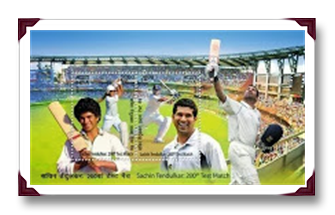
SACHIN TENDULKAR POSTAGE STAMP RELEASED :-

SACHIN TENDULKAR   POSTAGE STAMP RELEASED :-
 

Sachin Ramesh  Tendulkar and Union Law Minister Kapil Sibal with a stamp released on his name by Department of Posts ahead of his 200th and the last test match at Wankhede Stadium in Mumbai on Nov.14, 2013.  The master blaster is the only Indian living person after Mother Teresa to receive this honour. 

Courtesy : http://www.7thpaycommissionnews.com/
0 comments

Sibal unveils special edition Tendulkar stamps

Mumbai, Nov 14: India's Law Minister Kapil Sibal Thursday unveiled special edition postage stamps on master blaster Sachin Tendulkar at a felicitation ceremony to mark his 200th and final Test match at the Wankhede stadium here. Also present at the ceremony were union Agriculture Minister Sharad Pawar, BCCI chief N Srinivasan and vice president Rajeev Shukla.

          While Srinivasan gifted Tendulkar a memento and a painted portrait, all Pawar, a former BCCI and ICC president and also a chief critic of Srinivasan, got to do was pose with one of the stamps released by Sibal and felicitate senior West Indies batsman Shivnarine Chanderpaul, who is playing his 150th Test match. Pawar left the venue soon after the felicitation got over. India skipper MS Dhoni gifted the legend a special cap that had '200' printed on its brim. The West Indies team also joined the celebration by presenting him a framed autographed shirt. The coin for the toss was also specially minted for Tendulkar. Tendulkar's coach Ramakant Achrekar was the first to enter the Wankhede stadium. He was followed by Tendulkar's family and the commentary team of host broadcaster, Star Sports. Legendary Australian spinner Shane Warne flew down from Sydney to witness Tendulkar's final match.

0 comments

Cricket God : Sachin Ramesh Tendulkar : An Inspiration to All


Tendulkar (born 24 April 1973) is an Indian Cricketer. Cricket as popularly known as ‘The game of uncertainty’ has certainly provided us with a big name to cherish. Often known as ‘The God of cricket’, ‘the master blaster’ and ‘the little master’,  holds several batting records, including the most Test centuries and the most one-day international centuries, and was rated in 2002 by Wisden as the second greatest Test batsman ever, after Sir Don Bradman. He received the Rajiv Gandhi Khel Ratna, India’s highest sporting honour, for 1997-1998, and the civilian award Padma Shri in 1999. Tendulkar was a Wisden Cricketer of the Year in 1997. 
 
0 comments

BLOOD TYPES & ITS MATCHING GROUP


0 comments

First in India in Governance

First in India in Governance

• President of the Indian National Congress— Womesh Chandra Bannerjee, 1885
• President of the Indian National Congress of independent India— Acharya Kripalani, till Nov 1947
• President— Rajendra Prasad (1950–1962)
• First Woman President— Pratibha Patil (2007–2012)
• The first Chief Election Commissioner — Sukumar Sen


• Industries and Supplies Minister— Shyama Prasad Mukherjee
• The first person to resign from the Central Cabinet— Shyama Prasad Mukherjee
• Vice-President— Sarvepalli Radhakrishnan
• Prime Minister— Jawaharlal Nehru (1947–1964). India held its first constitutional elections in 1952 after which he was re-elected.
• Deputy Prime Minister— Vallabhbhai Patel (1947–1950)
• Law Minister of India— B. R. Ambedkar
• Leader of Opposition— A. K. Gopalan
• Prime Minister to be voted out of office— Indira Gandhi (1977), when the Indian National Congress lost to the Janata Party
• Non-Congress government— Janata Party, with Morarji Desai as the Prime Minister (1977–1980)
• Non-Congress State government with Majority by a single party— E. M. S. Namboodiripad of CPI, Kerala 1957
• Prime Minister to lead a minority government for a full term (five years)— P. V. Narasimha Rao, 21 June 1991 – 16 May 1996
• Person outside the Nehru-Gandhi family to serve as Prime Minister for a full term (five years)— P. V. Narasimha Rao, 21 June 1991 – 16 May 1996
• Prime Minister from South India— P. V. Narasimha Rao, 1991, H.D.Deve Gowda
• Women Railway Minister of India— Mamata Banerjee[18]
• The first Viceroy of India— Lord Canning, 1858
• Governor-General of Independent India— Lord Mountbatten, 1947
• Indian Governor-General of Indian Union— C Rajagopalachari, 1948
• Chief Justice of India— H. J. Kania (1947–1951)
• First Sikh Prime Minister— Manmohan Singh (2004–present)
• First Muslim President— Zakir Hussain (1967–1969)
• First Sikh President— Giani Zail Singh
• First Chief Minister of West Bengal— Dr. Prafulla Chandra Ghosh
• Indian ICS Officer— Satyendranath Tagore, 1863
• Speaker of Lok Sabha— G.V. Mavlankar (1952–1956)
• Finance Minister of Independent India— R.K. Shanmukhan Chetty (1947–1949), for others see First Indian Cabinet
• Presentation of First Budget after India's Independence— R. K. Shanmukhan Chetty on 26 November 1947
• First Home Minister of India— Sardar Vallabh Bhai Patel[19]
• First Indian President to die in Office— Dr Zakir Hussain, 3 May 1969
• First Chief Minister to die in Office— C.N.Annadurai, Tamil Nadu
• First Indian Prime Minister to resign from office— Morarji Desai, 1979
• First Woman Cabinet Minister in India— Rajkumari Amrit Kaur
• First Woman Minister in India— Vijaya Lakshmi Pandit
• First Woman Chief Minister— Sucheta Kriplani
• First Female Home Minister— Sabitha Indra Reddy in Andhra Pradesh Govt.
• First Woman Speaker of the Lok Sabha— Meira Kumar
• First Woman Finance Minister of State Government in India— Dr Upinderjit Kaur, in Punjab Govt.

0 comments

LIST OF IMPORTANT AWARDS

LIST OF IMPORTANT AWARDS 

1. Man Booker Prize 2013 - Eleanor Catton (for The Luminaries)
2. Man Booker International Prize - Lydia Davis
3. Asia Pacific International Award - Dr. Mujeeb Athar
4. Cecil B Demile Award - Woody Allen
5. Champion for Global Change Award 2013 - Malala Yousafzai


6. First Mahathir Award for Global Peace - Nelson Mandela
7. German Whistleblower Prize 2013 - Edward Snowden
8. Golden Lion at Venice Film Festival - Sacro GRA (Italy)
9. Grand Prize at Cuba's International Radio and Telivision Festival - Baraksat (Lebanese Documentary)
10. IMPAC Dublin Literary Award - Kevin Barry
11. INDEX Design Award - Kavitha Shukla
12. ISRO Young Scientist Award - Jenita Mary
13. Jnanpith Award 2012 - Ravuri Bharadhwaja
14. Knighthood, which is the highest honour of Britain - Anish Kapoor (sculptor)
15. Lata Mangeshkar Samman Alankaran - Hariharan
16. 'Legend of Planet' award - Bindeshwar Pathak (Sulabh movement founder)
17. Library of Congress Gershwin Award - Carole King (first woman)
18. National Literacy Award - Chattisgarh
19. NSS Wernher von Braun Memorial Award - Abdul Kalam
20. NTR National Literary Award - Manoj Das
21. Sree Narayan Guru Global Secular & Peace Award 2013 - Shashi Tharoor
22. Presidential medal of freedom - Dr. Sally Ride
23. Pulitzer Prize for fiction in 2013 - Adam Johnson (for the novel “The
Orphan Master’s son”)
24. Rajiv Gandhi Khel Ratna - Ranjan Sodhi
25. Saraswati Samman (2013) – Sugathakumari
26. Skoch Group Award - Jharkhand
27. Tagore Award for Cultural Harmony - Zubin Mehta
28. Tagore Peace Prize - Shihab Ghanem (first Arab)
29. The Simón Bolívar National Award of Journalism 2013 - Hugo Chavez (late Venezuelan President )
30. U. N. Champions of the Earth Award - V. Ramanathan
31. UEFA Best Player in Europe Award - Franck Ribéry
32. UN’s Public Service Award - Omen Chandi (Kerala CM)
33. Unique Female Leader Award - Madeleine Albrite (former US Secratary)
34. United Nation's Public Service Award - Oommen Chandy (Chief Minister of Kerala)
35. US "woman of courage" award - Nirbhaya (Dehli gang rape victim)
36. Vyas Samman (2012) – Narendra Kohli
37. Whitley award (Green Oscar) - Dr. Aparajita Datta
38. Women’s Prize for Fiction - AM Homes (for her book, May We Be Forgiven)
39. Youngest Indian to scale the Mount Everest - Raghav Joneja
40. ParliamentarianAwards - 2012 - Sharad Yadav
0 comments

Some Amazing Facts about India :

Some Amazing Facts about India :

* India is the world's largest, oldest, continuous civilization.

* India is the world's Largest democracy.

* India never invaded any country in her last 1000 years of history.

* India invented the number system. Zero was invented by Aryabhatta.

* When many cultures were only nomadic forest dwellers over 5000 years ago, Indians established Harappan culture in Sindhu Valley (Indus Valley Civilization)

* There are 300,000 active mosques in India , more than in any other country, including the Muslim world

* Sanskrit is the mother of all the European Languages . Sanskrit is the most suitable language for computer software - a report in Forbes magzine July 1987.

* Chess (Shataranja or AshtaPada) was invented in India.

* India has the second largest pool of Scientist and Engineers in the World.

* India is the largest English speaking nation in the world.

* India is the only country other than US and Japan, to have built a super computer indeigenously.

* India has the largest number of Post Offices in the world

* One of the largest employer in the world is the Indian Railways , employing over a million people

* India was one of the richest countries till the time of British rule in the early 17th Century. Christopher Columbus, attracted by India's wealth, had come looking for a sea route to India when he discovered America by mistake.

* The Baily Bridge is the highest bridge in the world. It is located in the Ladakh valley between the Dras and Suru rivers in the Himalayan mountains. It was built by the Indian Army in August 1982

* The Vishnu Temple in the city of Tirupathi built in the 10th century, is the world's largest religious pilgrimage destination. Larger than either Rome or Mecca, an average of 30,000 visitors donate $6 million (US) to the temple everyday.

* Varanasi, also known as Benaras, was called "the Ancient City" when Lord Buddha visited it in 500 B.C., and is the oldest, continuously inhabited city in the world today.

* Martial Arts were first created in India, and later spread to Asia by Buddhist missionaries.

* Yoga has its origins in India and has existed for over 5,000 years.

0 comments

Some Important Companies with Full Names


3M — Minnesota Mining and Manufacturing Company
AT&T — American Telephone and Telegraph Company
Adidas — Adolf (Adi) Dassler
Amoco — AMerican Oil COmpany
AOL —America Online
Amul— Anand Milk Union Limited
BMW— Bayerische Motoren Werke
BBC — British Broadcasting Corporation
BenQ — Bringing Enjoyment and Quality
BHP — Broken Hill Proprietary
BSNL — Bharat Sanchar Nigam Limited
BP — British Petroleum
BPL — British Physical Laboratories
BASF— Baden Aniline and Soda Factory
BEML— Bharat Earth Movers Limited
BHEL— Bharat Heavy Electricals Limited
CEAT — Cavi Elettrici e Affini Torino
Capcom— Capsule Computers
CDAC — Centre for Development of Advanced Computing
COLT — City Of London Telecom
ESPN— Entertainment and Sports Programming Network
HDFC— Housing Development Finance Corporation Limited
HCL— Hindustan Computer Limited
HTC— High Tech Computer CorporationHP
HP — Hewlett-Packard
HMV — His Master's Voice
HSBC— Hongkong and Shanghai Banking Corporation
H&M— Hennes & Mauritz
ICICI Bank— Industrial Credit and Investment Corporation of India Bank
IBM— International Business Machines
Infosys— Information Systems
Intel— INTegrated ELectronics
IKEA— Ingvar Kamprad Elmtaryd Agunnaryd
ING— International Netherlands GroupLarsen & Toubro
JVC— Japan Victor Company
JBL— James Bullough Lansing
KFC— Kentucky Fried Chicken
L&T— Larsen & Toubro
LG— Lucky and Goldstar
LEGO— leg godt
MRF — Madras Rubber Factory
NEC— Nippon Electric Company
Nikon — Nippon KogakuProcter Gamble
Nissan— Nippon Sangyo
P&G — Procter & Gamble Company
SAP— System Analyse und Programmentwicklung
TCL— Today China Lion
UPS— United Parcel Service of America
Wipro— Western India Palm Refined Oil Ltd
0 comments

Multi-National Corporations & their Headquarters


PepsiCo— Purchase, New York, USA
Nestle— Vevey, Switzerland
Microsoft— Redmond, Washington, USA
Coca-Cola— Atlanta, Georgia, USA
Apple— Cupertino, California, USA
Nokia— Espoo, Finland
Home Depot— Vinings, Georgia, USA
Berkshire Hathaway— Omaha, Nebraska, USA
BP— London, United Kingdom
Total S.A. — La Defense, Paris, France
UPS— Sandy Springs, Georgia, USA
ConocoPhillips— Houston, Texas, USA
Fiat— Turin, Italy
Toshiba— Tokyo, Japan
Kroger— Cincinnati, Ohio, USA
Costco— Issaquah, Washington
Unilever— London, UK and Rotterdam, The Netherlands
Honda— Tokyo, Japan
Volvo— Gothenburg, Sweden
Target— Minneapolis, Minnesota, USA
BMW— Munich, Germany
Sears Holding— Hoffman Estates, Illinois, USA
Boeing— Chicago, Illinois, USA
DaimlerChrysler — Stuttgart, Germany and Auburn Hills, Michigan, USA
Fedex— Memphis, Tennessee, USA
Vodafone— Newbury, England, UK
AXA— Paris, France
Motorola— Schaumburg, Illinois, USA
Petronas— Kuala Lumpur, Malaysia
Toyota— Toyota, Japan
Procter & Gamble— Cincinnati, Ohio, USA
Pfizer— New York, USA
Ford— Dearborn, Michigan, USA
Lockheed Martin— Bethesda, Maryland, USA
Fortis— Brussels, Belgium and Utrecht, The Netherlands
Halliburton— Houston, Texas, USA
J.P. Morgan Chase & Co. — New York City, USA
BASF— Ludwigshafen, Germany
Sony— Tokyo, Japan
Siemens— Munich, Germany
Northrop Grumman— Los Angeles, California, USA
Citigroup— New York City, USA
Volkswagen— Wolfsburg, Germany
Pemex— Mexico City, Mexico
Reliance Industries— Mumbai, India
ING Group— Amsterdam, The Netherlands
Morgan Stanley —New York, USA
General Motors— Detroit, Michigan, USA
Hyundai— Seoul, South Korea
Staples— Framingham, Massachusetts, USA
Walmart— Bentonville, Arkansas, USA
Dell— Round Rock, Texas, USA
IBM— Armonk, New York, USA
HBOS— Edinburgh, Scotland
Nike— Beaverton, Oregon, USA
IKEA— Leiden, The Netherlands
Samsung Electronics— Seoul, South Korea
McDonalds— Oak Brook, Illinois, USA
Michelin— Clermont-Ferrand, France
ExxonMobil— Irving, Texas, USA
Royal Dutch Shell— The Hague, The Netherlands
Walt Disney— Burbank, California, USA
HP— Palo Alto, California, USA
Canon— Tokyo, Japan
Verizon— New York, USA
General Electric — Fairfield, Connecticut, USA
Chevron— San Ramon, California, USA
UBS— Basel & Zurich, Switzerland
Bank of America— Charlotte, North Carolina, USA
Allianz— Charlotte, North Carolina, USA
LG— Seoul, South Korea
Sprint Nextel— Overland Park, Kansas, USA.
Deutsche Bank— Frankfurt am Main, Germany
Intel— Santa Clara, California, USA
Peugeot— Paris, France
0 comments

First in India in Governance


• President of the Indian National Congress— Womesh Chandra Bannerjee, 1885
• President of the Indian National Congress of independent India— Acharya Kripalani, till Nov 1947
• President— Rajendra Prasad (1950–1962)
• First Woman President— Pratibha Patil (2007–2012)
• The first Chief Election Commissioner — Sukumar Sen
• Industries and Supplies Minister— Shyama Prasad Mukherjee
• The first person to resign from the Central Cabinet— Shyama Prasad Mukherjee
• Vice-President— Sarvepalli Radhakrishnan
• Prime Minister— Jawaharlal Nehru (1947–1964). India held its first constitutional elections in 1952 after which he was re-elected.
• Deputy Prime Minister— Vallabhbhai Patel (1947–1950)
• Law Minister of India— B. R. Ambedkar
• Leader of Opposition— A. K. Gopalan
• Prime Minister to be voted out of office— Indira Gandhi (1977), when the Indian National Congress lost to the Janata Party
• Non-Congress government— Janata Party, with Morarji Desai as the Prime Minister (1977–1980)
• Non-Congress State government with Majority by a single party— E. M. S. Namboodiripad of CPI, Kerala 1957
• Prime Minister to lead a minority government for a full term (five years)— P. V. Narasimha Rao, 21 June 1991 – 16 May 1996
• Person outside the Nehru-Gandhi family to serve as Prime Minister for a full term (five years)— P. V. Narasimha Rao, 21 June 1991 – 16 May 1996
• Prime Minister from South India— P. V. Narasimha Rao, 1991, H.D.Deve Gowda
• Women Railway Minister of India— Mamata Banerjee[18]
• The first Viceroy of India— Lord Canning, 1858
• Governor-General of Independent India— Lord Mountbatten, 1947
• Indian Governor-General of Indian Union— C Rajagopalachari, 1948
• Chief Justice of India— H. J. Kania (1947–1951)
• First Sikh Prime Minister— Manmohan Singh (2004–present)
• First Muslim President— Zakir Hussain (1967–1969)
• First Sikh President— Giani Zail Singh
• First Chief Minister of West Bengal— Dr. Prafulla Chandra Ghosh
• Indian ICS Officer— Satyendranath Tagore, 1863
• Speaker of Lok Sabha— G.V. Mavlankar (1952–1956)
• Finance Minister of Independent India— R.K. Shanmukhan Chetty (1947–1949), for others see First Indian Cabinet
• Presentation of First Budget after India's Independence— R. K. Shanmukhan Chetty on 26 November 1947
• First Home Minister of India— Sardar Vallabh Bhai Patel
• First Indian President to die in Office— Dr Zakir Hussain, 3 May 1969
• First Chief Minister to die in Office— C.N.Annadurai, Tamil Nadu
• First Indian Prime Minister to resign from office— Morarji Desai, 1979
• First Woman Cabinet Minister in India— Rajkumari Amrit Kaur
• First Woman Minister in India— Vijaya Lakshmi Pandit
• First Woman Chief Minister— Sucheta Kriplani
• First Female Home Minister— Sabitha Indra Reddy in Andhra Pradesh Govt.
• First Woman Speaker of the Lok Sabha— Meira Kumar
• First Woman Finance Minister of State Government in India— Dr Upinderjit Kaur, in Punjab Govt.
0 comments

Number Notation

Hierarchy of Decimal Numbers
Number
Name
How many
0zero 
1one
2two 
3three  
4four   
5five    
6six     
7seven      
8eight       
9nine        
10ten         
20twentytwo tens
30thirtythree tens
40fortyfour tens
50fiftyfive tens
60sixtysix tens
70seventyseven tens
80eightyeight tens
90ninetynine tens
NumberNameHow Many
100one hundredten tens
1,000one thousandten hundreds
10,000ten thousandten thousands
100,000one hundred thousandone hundred thousands
1,000,000one millionone thousand thousands
Some people use a comma to mark every 3 digits. It just keeps track of the digits and makes the numbers easier to read.
Beyond a million, the names of the numbers differ depending where you live. The places are grouped by thousands in America and France, by the millions in Great Britain and Germany.
NameAmerican-FrenchEnglish-German
million1,000,0001,000,000
billion1,000,000,000 (a thousand millions)1,000,000,000,000 (a million millions)
trillion1 with 12 zeros1 with 18 zeros
quadrillion1 with 15 zeros1 with 24 zeros
quintillion1 with 18 zeros1 with 30 zeros
sextillion1 with 21 zeros1 with 36 zeros
septillion1 with 24 zeros1 with 42 zeros
octillion1 with 27 zeros1 with 48 zeros
googol
1 with 100 zeros
googolplex
1 with a googol of zeros
FractionsDigits to the right of the decimal point represent the fractional part of the decimal number. Each place value has a value that is one tenth the value to the immediate left of it.
NumberNameFraction
.1tenth1/10
.01hundredth1/100
.001thousandth1/1000
.0001ten thousandth1/10000
.00001hundred thousandth1/100000
Examples:
0.234 = 234/1000 (said - point 2 3 4, or 234 thousandths, or two hundred thirty four thousandths)
4.83 = 4 83/100 (said - 4 point 8 3, or 4 and 83 hundredths)
SI Prefixes
NumberPrefixSymbol
10 1deka-da
10 2hecto-h
10 3kilo-k
10 6mega-M
10 9giga-G
10 12tera-T
10 15peta-P
10 18exa-E
10 21zeta-Z
10 24yotta-Y
NumberPrefixSymbol
10 -1deci-d
10 -2centi-c
10 -3milli-m
10 -6micro-u (greek mu)
10 -9nano-n
10 -12pico-p
10 -15femto-f
10 -18atto-a
10 -21zepto-z
10 -24yocto-y
Roman Numerals
I=1 (I with a bar is not used)
V=5 _
V=5,000
X=10 _
X=10,000
L=50 _
L=50,000
C=100 _
C = 100 000
D=500 _
D=500,000
M=1,000 _
M=1,000,000
1 = I

2 = II

3 = III

4 = IV

5 = V

6 = VI

7 = VII

8 = VIII

9 = IX

10 = X
11 = XI

12 = XII

13 = XIII

14 = XIV

15 = XV

16 = XVI

17 = XVII

18 = XVIII

19 = XIX

20 = XX

21 = XXI
25 = XXV

30 = XXX

40 = XL

49 = XLIX

50 = L

51 = LI

60 = LX

70 = LXX

80 = LXXX

90 = XC

99 = XCIX

There is no zero in the roman numeral system.
The numbers are built starting from the largest number on the left, and adding smaller numbers to the right. All the numerals are then added together.
The exception is the subtracted numerals, if a numeral is before a larger numeral, you subtract the first numeral from the second. That is, IX is 10 - 1= 9.
This only works for one small numeral before one larger numeral - for example, IIX is not 8, it is not a recognized roman numeral.
There is no place value in this system - the number III is 3, not 111.
Number Base Systems
Decimal(10)
Binary(2)
Ternary(3)
Octal(8)
Hexadecimal(16)
0
0
0
0
0
1
1
1
1
1
2
10
2
2
2
3
11
10
3
3
4
100
11
4
4
5
101
12
5
5
6
110
20
6
6
7
111
21
7
7
8
1000
22
10
8
9
1001
100
11
9
10
1010
101
12
A
11
1011
102
13
B
12
1100
110
14
C
13
1101
111
15
D
14
1110
112
16
E
15
1111
120
17
F
16
10000
121
20
10
17
10001
122
21
11
18
10010
200
22
12
19
10011
201
23
13
20
10100
202
24
14
Each digit can only count up to the value of one less than the base. In hexadecimal, the letters A - F are used to represent the digits 10 - 15, so they would only use one character.
Courtesy : http://systempost.blogspot.in
0 comments
 
Support : Creating Website | Johny Template | Mas Template
Copyright © 2011. மானாமதுரை அஞ்சல் - All Rights Reserved
Template Created by Creating Website Published by Mas Template
Proudly powered by Blogger